How to Get Your Business Recommended by ChatGPT in India (2026)
By Paras Chaturvedi, freelance full stack developer based in India. Updated November 2026.
You cannot pay to get your business recommended by ChatGPT. It names businesses it can read and trust: complete Google and directory listings with genuine reviews, the same name, address and phone number everywhere, and a website with clear service, area and price pages its crawler can reach. ChatGPT ads now run in India, but they sit apart from the answer.
Since 10 November 2026, some businesses can also claim a profile inside ChatGPT, and that starts with a website too. This matters here because India is now ChatGPT’s largest market by weekly active users. I tested ChatGPT on businesses in my own city, and the five checks further down are what I would fix before spending a rupee on “AI SEO”.
Key takeaways
- To get your business recommended by ChatGPT, work in this order: let crawlers in, complete your listings and reviews, publish one page per service, keep your details identical everywhere, and check monthly.
- You can run a labelled ChatGPT ad in India, but you cannot pay to be named in its answers, and Google says you cannot pay for a better local ranking either.
- When I asked ChatGPT for the best businesses in my city, every name had a listing rating of 4.7 or more and at least 29 reviews.
- Indian online stores and online service firms can now claim a ChatGPT profile. Local clinics, salons and shops cannot yet.
- In BrightLocal’s study of local AI answers, business websites together made up 42% of citations. Google Business Profile was the biggest single site, at 28.5%, but ChatGPT hardly used it.
- Among US consumers who already use AI for local searches, only 18% felt ready to contact the business it recommended, so your website still has to win the enquiry.
Can you pay, advertise or apply to get your business recommended by ChatGPT?
You can buy an ad, but you cannot buy a recommendation. Since 31 August 2026, Indian businesses can run self-serve ChatGPT Ads, which TechCrunch reported are shown to Free and Go users, with a minimum daily budget of ₹725. OpenAI says these ads are labelled, sit apart from ChatGPT’s answers and do not influence them. Its help page for businesses says the same.
What changed on 10 November 2026 is that eligible businesses can claim and verify a profile, and OpenAI is clear that even this does not guarantee better placement. Google’s local ranking help page goes further: there is no way to request or pay for a better local ranking.
The AI tools have not caught up yet. On 25 November 2026, ChatGPT told me a small Indian business cannot pay or apply to guarantee a recommendation, and Bing’s AI answer said there was no submission form. Neither mentioned the claim option, live for two weeks by then. If you ask an AI tool about this, check what it says against OpenAI’s own page.
What ChatGPT showed me when I asked about businesses in my city
The test I ran
On 25 November 2026 I ran a test in ChatGPT, logged out, with web search on. I asked two things a customer here might type, both naming my city: which is the best physiotherapy clinic and, about my own trade, who is the best website developer for a small business website.
I ran each question once. That is a tiny sample and answers change between runs, so treat it as a snapshot. I am not naming the businesses here.
What every recommended business had in common
For physio, ChatGPT showed four clinics on a map card, each rated 4.9 to 5.0 with 72 to 121 reviews, plus its area, phone number and whether it was open right then. It added that these were directory ratings and no guarantee of how treatment would go.
The developer question gave five firms, rated 4.7 to 5.0 with 29 to 115 reviews, again with area and phone. It also showed a rough website price table, ₹5,000 to ₹50,000 and up, with no source I could see. As with the physio answer, ChatGPT said only that the ratings came from business listings.
My own name was not on the list. I would rather say so than pretend otherwise, because it tells me what to work on, the same way it tells you.
What this tells a business owner
For “best X in my city” questions, the shortlist was built on listing data: rating, review count, address and phone.
A much bigger dataset backs this up. SOCi, which sells local marketing software, studied more than 350,000 locations of 2,751 multi-location brands and reported in January 2026 that ChatGPT recommended just 1.2% of them, and those it picked averaged 4.3 stars.
It is vendor research, and its 4.3 average is lower than the 4.7 and up I saw in my city, but it points the same way: well-rated listings get picked. Listings and reviews get you onto the shortlist. After that, as the survey figures further down show, many customers still check your website before they call.
Where do ChatGPT and Google AI Mode get information about your business?
Mostly from business websites. Google’s AI Mode and AI Overviews also lean heavily on Google Business Profiles, but BrightLocal found ChatGPT hardly uses them and leans more on Yelp and Bing.
BrightLocal’s Local AI Visibility Study (September 2026) tracked nearly 2 million citations across ChatGPT, Google AI Mode and AI Overviews for about 1,300 business locations. Business websites made up 42% of citations and 93% of the different domains cited. Google Business Profile was the biggest single site at 28.5%, with Yelp next at 9.5%.
Tracked businesses were named in 66% of Google Maps searches, 38% in AI Overviews, 33% in ChatGPT and 32% in AI Mode. The study’s examples are US cities, so treat the exact figures with care.
For India, I could not find any OpenAI statement on which listings ChatGPT uses. Its search help page says nearby business listings come from “trusted third-party providers” and does not name them. So for ChatGPT here, I would put the effort into your website and the directories that already show up for your city.
Google and OpenAI also spell out what they need from your site. Google’s guide to AI features and your website says AI Overviews and AI Mode need no special optimisation: the page must be indexed and eligible to show with a snippet, and your Business Profile should be up to date.
OpenAI’s ChatGPT search help page says a site must allow the OAI-SearchBot crawler, and its host or CDN must not block OpenAI’s crawler IP addresses. The same page says ChatGPT search sometimes sends questions to other search providers, and it lists Microsoft, which runs Bing, among them.
Can Indian businesses claim a profile in ChatGPT’s Business Hub?
Some can. When I checked OpenAI’s pages on 25 November 2026, ecommerce and online service businesses based outside the US had been eligible to claim since a 19 November update. Local stores and restaurants could claim only an existing US listing, so an Indian clinic, salon or shop cannot claim yet. Eligibility also depends on industry, location and OpenAI’s own checks.
What Business Hub is
Business Hub is OpenAI’s dashboard for claiming and managing how your business appears in ChatGPT, which OpenAI says 1.2 billion people use each week. Once verified, you can edit your description, category, logo and delivery and return policies, and connect a product feed with prices and stock. It also shows your mentions, website clicks and the topics of conversations where your site was cited.
Who can claim from India today
| Business type | Can you claim now? | What to do meanwhile |
|---|---|---|
| D2C brand or online store (Shopify, WooCommerce) | Yes, as ecommerce. Shopify stores can verify by connecting the store. | Claim, add a product feed, keep product pages complete. Still choosing? See WooCommerce vs Shopify for Indian stores. |
| Online service business (consultant, agency, online coach, SaaS) | Yes, as an online service. | Claim with your domain or business email, and match your service pages to the profile. |
| Local clinic, salon, shop or restaurant | Not yet. Local stores and restaurants can claim only existing US listings. | Work on your Google Business Profile, reviews and website. Check again monthly. |
These rules changed once in the first fortnight, so read OpenAI’s current Businesses in ChatGPT page before planning around them.
Why your domain and business email should be in your name
To claim, you prove the business is yours: a code to the listed phone number, a code to your business email, a TXT record on your domain’s DNS, or connecting a Shopify store. Then an identity service called Persona checks who you are, and it can ask for government ID and business registration details, before you can publish changes or see insights.
Check now who holds the login for your domain. If it sits in an old developer’s or agency’s account, you cannot add a TXT record to it, and the DNS route is closed to you.
Ask whoever registered it to move it to an account in your name, and keep the password yourself. I bill domain and hosting at cost, in the client’s name, partly for this reason.
What claiming will not do
OpenAI’s Businesses in ChatGPT page puts it in one line: “Claiming does not guarantee higher placement or sales.” So no agency can promise you a place either. Claim for accurate details and the insights, then work through the five checks below.
The CLAIM check: five things to sort out before anything else
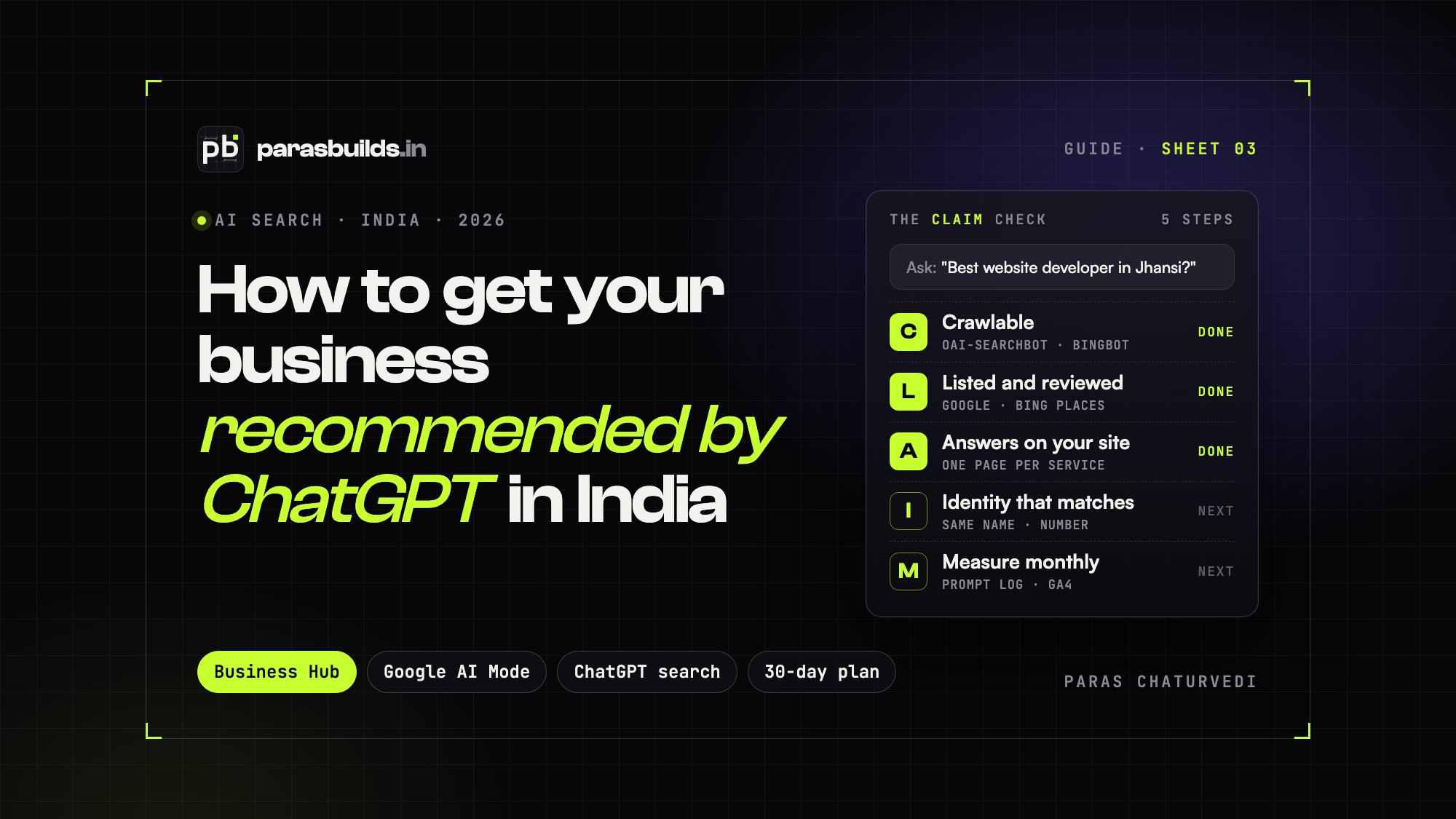
This is the order I would check any business website in. The letters spell CLAIM, a reminder that claiming a profile comes last.
C for Crawlable: let Googlebot, Bingbot and OAI-SearchBot in
If crawlers cannot fetch your pages, nothing else matters. OpenAI’s crawler documentation says sites that opt out of OAI-SearchBot will not be shown in ChatGPT search answers.
- Open yourdomain.in/robots.txt and check nothing blocks Googlebot, Bingbot or OAI-SearchBot.
- Ask your host whether its firewall or CDN blocks bots. OpenAI publishes its crawler IP ranges for this.
- Check no key page is set to noindex. In WordPress, the “Discourage search engines” box left ticked after launch does this to the whole site.
- Use URL Inspection in Google Search Console to confirm your main pages are indexed.
- Add your site to Bing Webmaster Tools and submit your sitemap there as well. Microsoft is one of the search providers ChatGPT search sometimes sends questions to.
A minimal robots.txt that lets all three in:
User-agent: OAI-SearchBot
Allow: /

User-agent: Googlebot
Allow: /

User-agent: Bingbot
Allow: /

Sitemap: https://yourdomain.in/sitemap.xml
GPTBot is a separate OpenAI crawler for model training, so blocking it is a different decision. OpenAI says robots.txt changes take about a day to reach its search systems.
Who does it: your developer.
L for Listed and reviewed: Google, Bing and the directories your customers use
For Google’s AI answers, your Google Business Profile carries the most weight. For ChatGPT, your other listings and your website count for more. Google ranks local results on relevance, distance and prominence, and prominence includes how many reviews you have.
- Fill every field: categories, services, hours, service area and photos of the real place.
- Ask every happy customer for a review that names the service. A WhatsApp message with your review link, sent the same day, is the easiest ask.
- Reply to reviews, good and bad.
- Claim your Bing Places listing too. Microsoft lets you import your Google Business Profile, which also verifies the Bing listing.
- Keep JustDial, IndiaMART or Practo listings consistent with your Google profile. I treat these as places customers look, not proven AI sources.
Mentions on other sites can help as well. In BrightLocal’s study, AI answers also cited directories such as Facebook, Tripadvisor and the Better Business Bureau alongside business websites. Get onto the lists where you genuinely belong, such as your professional institute’s directory or your trade association’s member list, and into the local news sites that cover your area. Never pay for a fake listing.
One catch for D2C brands: Google only gives a Business Profile to a business customers can visit, or one that travels to them. Sell only online and you will not qualify, so your website and a Business Hub claim carry more weight.
Who does it: you.
A for Answers on your website: one page per service and one per area
A page that answers one clear question is easy to quote. Take a clinic site with a single “Services” page that lists twelve treatments in a line each. There is very little there for an AI tool to use. Give each treatment its own short page saying what it is and what it costs, and you have twelve answers instead of one list.
That is how I built the website for Acenteus Accounting, a UK firm: one page per service, and a blog answering the questions clients ask.
- One page per main service, opening with what it is, who it suits and the price or a range.
- Your process and timeline as steps.
- FAQs in the words customers use on the phone, including Hindi or Hinglish if that is how they search.
- Real photos, staff names and qualifications, address and map.
Price is what owners resist most. I publish mine, with a full breakdown of what a website costs in India, because a page with a real figure on it gives a customer, and an AI tool, something to quote.
Who does it: you write, your developer builds.
I for Identity that matches everywhere
Details that do not match work against you. If your website shows one name, your Google profile a slightly different one, and an old directory lists a number you stopped using years ago, you look like two businesses or an unreliable one.
- Use the same name, address and phone number on your site, Google profile, directories and social pages.
- Add Organization or LocalBusiness schema with sameAs links to your official profiles. Google’s advice on AI search is to keep everything in your markup visible on the page.
Schema is housekeeping. Google says its AI features need no special schema, so it will not get you recommended on its own. I add it anyway because it puts your name, address and official profiles in one place a machine can read.
Who does it: you fix listings, your developer adds schema.
M for Measure every month
There is no ChatGPT ranking report, so keep your own log.
- Write 10 questions customers would ask, such as “best CA for GST filing in my city” or “orthopaedic doctor near me”.
- Monthly, ask each in ChatGPT, Google AI Mode, Gemini and Perplexity. Note the date, who was named and which sources appeared.
- Check GA4 for referral visits from AI tools, and Search Console for queries reaching your service pages.
- If you claimed a Business Hub profile, read its mentions and clicks.
Who does it: you keep the log; your developer sets up GA4 and Search Console.
Why this matters for Indian businesses now
Your customers are already asking these tools. In February 2026 Sam Altman said India had 100 million weekly ChatGPT users. On 3 November 2026, OpenAI’s India MD Prabhjeet Singh said India had become the largest market by weekly users, with the base doubled since January.
Google’s AI Mode passed 1 billion monthly active users in May 2026, and in India it works in English, Hindi and, since October 2025, seven more Indian languages: Bengali, Kannada, Malayalam, Marathi, Tamil, Telugu and Urdu. On Google Trends, Indian interest in “google ai mode” in the week of 22 November 2026 was about three times its level in the same week of 2025.
The best survey data is American: US consumers using AI tools for local recommendations jumped from 6% to 45% in a year, per BrightLocal. I found no reliable India figure, so I will not invent one.
But picture a patient typing “mere shahar mein achha physiotherapist” into AI Mode. If no clinic in town has a page that answers that plainly, the AI has only listings to go on. When I asked ChatGPT a similar question, every clinic it named had at least 72 reviews and a rating of 4.9 or more.
What does not work (or is oversold)
Much of what is sold as “ChatGPT SEO” right now is either free or pointless.
- Paying to be the answer. A ChatGPT ad can bring clicks, but it sits apart from the answer and will not get you named in it.
- A Custom GPT sold as a “listing”. At least one Indian agency guide teaches building one to “submit” your business. A Custom GPT is a chatbot you make. It does not put you in anybody else’s answers.
- Paid llms.txt or “AI schema” setups. llms.txt is still only a proposal, published by Jeremy Howard in September 2024. In June 2025 Google’s John Mueller said no AI system was using it, and Google’s current AI features guide says you need no AI text files or special schema to appear. I keep an llms.txt on my site because it costs nothing. Nobody should pay for one.
- Bought reviews. Reviews were the one thing every business ChatGPT named for me had in common, so do not risk yours on fakes. In BrightLocal’s 2026 survey, 57% of US consumers said a business caught using fake reviews should be banned from review platforms.
Getting named is half the job: will your website turn that visitor into an enquiry?
A recommendation is not a booking. BrightLocal’s July 2026 survey of 1,227 US consumers found that, among those already using AI for local searches, only 18% felt ready to contact the business an AI tool recommended.
Of those whose last search started on an AI tool, 43% went on to check Google. In BrightLocal’s February survey, 54% said they visit a business’s website after reading positive reviews.
There are also fewer visits to go round. In March 2025, Pew Research tracked the browsing of 900 US adults and found they clicked a normal result on 8% of visits to a results page with an AI summary, against 15% without one. Whoever does arrive needs to find the answer, and the button, fast.
The enquiry leaks I fix most often on Indian business sites
- No WhatsApp button or tap-to-call on mobile.
- A contact form that emails an inbox nobody checks.
- Slow mobile pages. Google’s Core Web Vitals are a good free yardstick.
- No price or range, and no word on what happens after someone enquires.
- Stock photos instead of the real shop, team or work.
- No address, map or opening hours.
- No GA4, so nobody knows where visitors drop off.
If your website is not getting leads even though people find you, start with this list. On the Scribble Masters website I built for a content writing firm in India, the enquiry form sits in the first screen and a WhatsApp chat button stays in reach.
A 30-day plan you can start this week
| Week | What to do | You or your developer |
|---|---|---|
| Week 1 | Complete your Google Business Profile and Bing Places listing, ask recent happy customers for reviews, run your first 10-question prompt log. | You |
| Week 2 | Check robots.txt, firewall and indexing in Search Console and Bing Webmaster Tools. Confirm the domain and business email are in your name. | Developer, with your logins |
| Week 3 | Build or rewrite service, area and FAQ pages, then add Organization or LocalBusiness schema. | You write, developer builds |
| Week 4 | Claim on Business Hub if eligible, check GA4 and Search Console, re-run the prompt log and compare. | You, with developer help for GA4 |
After that, keep the prompt log and review requests going monthly. This builds slowly, and the log is how you will see it working.
Do you need a developer for this?
For about half of it, no. Your Google Business Profile, Bing Places listing, reviews, the prompt log and a Business Hub claim are yours to do. The technical half needs a developer: robots.txt and CDN settings, indexing, service pages, schema, speed, GA4 and Search Console, and moving a domain into your name.
That half is my job. Design is by my team; I build, launch and support the site.
- Launch: ₹24,999, a landing page in 7 to 10 days.
- Business: ₹59,999, 5 to 8 pages in 3 to 4 weeks, which leaves room for proper service and area pages.
- Store: ₹1,24,999, WooCommerce or Shopify in 4 to 6 weeks.
Each includes on-page SEO, speed work, GA4 and Search Console, a WhatsApp button, an editable Elementor build and 30 days of support. Prices are plus GST if applicable. Domain and hosting are billed at cost in your name, and you pay a 50% advance via Razorpay.
Full details, including the Custom Web App plan from ₹2,49,999, are on my plans and pricing page.
I also see this from the tool side. At the digital agency where I work, I build DoctorFizz, an SEO and AI search audit tool, end to end. It compares a page with what ranks on Google and Bing and with the sources AI answers draw on. Read more about me or browse the sites and apps I have shipped since 2022.
Frequently asked questions
How do I get my business on ChatGPT?
You cannot submit or pay to appear in ChatGPT’s answers, and its ads sit apart from them. Complete your Google, Bing and directory listings, collect genuine reviews, keep your details identical everywhere and publish clear service pages that OAI-SearchBot can crawl. Online stores and online service businesses can also claim a profile in ChatGPT’s Business Hub.
Why is my business not showing up on ChatGPT?
Usually a thin listing with few reviews, a website that blocks OpenAI’s crawler or is not indexed, or details that do not match across the web. In my test in one Indian city, every recommended business had at least 29 reviews and a rating of 4.7 or higher. Answers vary between runs, so check more than once.
Can a business in India claim its profile on ChatGPT?
Yes, if it is an ecommerce or online service business. OpenAI opened claiming to those businesses outside the US on 19 November 2026. Local stores and restaurants can claim only existing US listings for now. You need a website and a way to verify, such as your domain or business email.
Do I need a website to show up in ChatGPT and Google AI Mode?
Not strictly, since strong listings can get you named. But business websites, taken together, were the biggest group of sources in BrightLocal’s study, and claiming in ChatGPT starts with a website. In BrightLocal’s February survey, 54% of US consumers said they check a business’s website after reading good reviews. An Instagram page has no service pages or prices for an AI tool to quote.
How long does it take to show up in ChatGPT’s answers?
There is no fixed timeline. OpenAI says robots.txt changes reach its search systems in about 24 hours, but reviews, listings and new pages take months to build. Run the same prompts monthly and compare. If an agency promises a date, ask how they could know.
Does ChatGPT use my Google reviews?
Not much, going by public data. BrightLocal’s 2026 study found Google Business Profile is a major source for Google’s AI Mode and AI Overviews but hardly used by ChatGPT, which leans more on Yelp and Bing. So keep Google reviews coming for Google’s answers, and collect reviews on the other directories customers in your city use.
How do I rank in Google AI Mode?
Google says AI Mode has no special requirements beyond normal search: your page must be indexed and eligible to show with a snippet. So the work is good local SEO: a complete Business Profile, clear service pages, a fast mobile site and a steady flow of genuine reviews.
Where to go from here
If you are not sure where your business stands, send me your website and Google Business Profile link through the contact page or on WhatsApp, and tell me what you sell. If you would rather compare costs first, the fixed-price plans are all on one page.