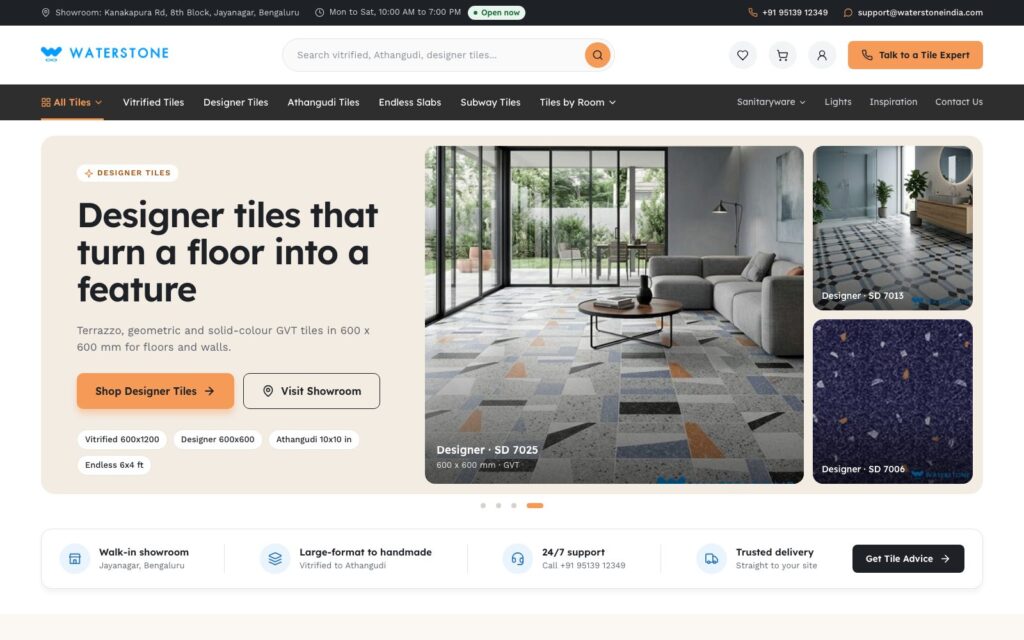
Waterstone India
A WooCommerce store for tiles and sanitaryware, with WhatsApp ordering.
I build online stores for Indian sellers on WooCommerce or Shopify, with Razorpay for UPI and cards, Cash on Delivery, shipping and GST invoices set up before launch. The Store plan is a fixed ₹1,24,999 plus GST if applicable, delivered in 4 to 6 weeks, with up to 50 products added and 30 days of support. Design by my team, built by me.
You get an online store on WooCommerce or Shopify that can take orders on launch day, with payments, Cash on Delivery, shipping and GST invoices already set up. It is one fixed price, ₹1,24,999, on either platform.
Not included: Shopify's subscription and app fees, product photos and copywriting. Domain, hosting, paid plugins and paid themes are billed at actual cost and registered in your name. Prices are plus GST if applicable.
It is for Indian sellers who want a store of their own instead of depending only on marketplaces or Instagram messages. That could be a D2C brand, a shop moving its catalogue online or a manufacturer selling direct.
It also suits products people think about before buying, where WhatsApp ordering can sit next to the normal checkout. If you need logic neither platform can handle, such as a custom portal, that is a custom web app, not a store.
Razorpay handles UPI, cards and netbanking, Cash on Delivery is set up with rules, and GST invoices and shipping are ready before launch.
On WooCommerce I use Razorpay's official Razorpay for WooCommerce plugin, which has 1,00,000+ active installations on WordPress.org and accepts UPI, cards, netbanking and wallets. On Shopify, Razorpay connects through its Razorpay Secure app. The Razorpay account is yours, so payments settle to your own bank account.
COD is part of free, core WooCommerce. Its Cash on Delivery settings let you offer it only on the shipping methods you choose. For tighter rules, a plugin can limit COD by pin code or order value. My advice on fake COD orders: keep COD for the pin codes and order sizes where a refused parcel will not hurt much, and steer bigger orders to prepaid UPI. On Shopify, COD is a manual payment method, and extra rules usually need an app.
Neither platform produces a complete GST invoice, with your GSTIN, HSN codes and the tax split shown properly, without extra setup. I add a GST invoice plugin on WooCommerce or an invoicing app on Shopify, billed at cost if it is a paid one. Shipping is set up before launch, and aggregators such as Shiprocket connect to both platforms, so labels and tracking happen inside the store.
With me, the build is ₹1,24,999 one-time, plus GST if applicable, on WooCommerce or Shopify. You pay ₹62,500 through Razorpay to start and the balance after you approve the finished store on staging, before it goes live.
Running costs are where the platforms differ, and you pay them whoever builds your store:
| Cost | WooCommerce | Shopify |
|---|---|---|
| Store build (my Store plan) | ₹1,24,999 one-time | ₹1,24,999 one-time |
| Platform fee | None, WooCommerce is free | Basic: ₹1,499 a month billed yearly, or ₹1,994 billed monthly |
| Hosting | Separate, a few thousand rupees a year for a small store | Included in the subscription |
| Fee on each payment | Razorpay's gateway fee | Razorpay's fee, plus a 2% third-party provider fee on Basic |
| Paid plugins or apps | At cost, in your name | At cost, in your name |
| Updates and backups | You, or a maintenance plan | Handled by Shopify |
Shopify figures are from its India pricing page, checked on 25 November 2026. For domain, hosting and every other line, read what a website costs in India.
For most small Indian stores I recommend WooCommerce: no monthly platform fee, full ownership and better blogging for SEO. Choose Shopify if you never want to think about hosting, updates or backups and are happy to pay monthly for that.
The Store plan costs the same on both, so I have no reason to push you either way. The full comparison, with fees, COD and GST, is in WordPress vs Shopify for Indian stores. Already decided? See my Shopify developer or WordPress developer pages.
Five steps take you from a first call to a live store in 4 to 6 weeks. The clock starts once the advance, your content and your logins are in.
Ready product photos and descriptions speed a store up more than anything else. Late content moves the date by the same amount.
A store with a handful of products and a standard theme is a fair DIY job on either platform. The fiddly parts are Razorpay setup, COD rules and a GST invoice that shows your GSTIN and HSN codes, and those are what the Store plan takes off your hands. Design is by my team; I build, launch and support the store.
The closest example is Waterstone India, a WooCommerce store I built for tiles and sanitaryware. Ready buyers get cart, checkout, wishlist and accounts; buyers who want to confirm a shade or stock first get WhatsApp ordering next to the normal checkout.
Ask every developer the same questions and compare the written answers, not only the price.
Two red flags: pirated, or "nulled", premium plugins, which come from the untrusted sources the WordPress hardening guide warns against, and a domain in the developer's name. Owning your domain matters more now, because Indian online stores can claim a ChatGPT Business Hub profile, and one way to verify is a record on your domain. More in my guide on getting your business recommended by ChatGPT.
Ready to start? Compare the packages on my plans and pricing page, or tell me what you sell and I will reply within one working day with a written quote.
A short call about your goals, then a written quote with scope and timeline.
Pay the advance on Razorpay. Invoice and kickoff form follow within one working day.
I map every page first, my design team draws the key screens, and we review them together.
I build on a private staging link you can check any time.
You approve and pay the balance. I launch and support you for 30 days.
With me, a fixed ₹1,24,999 plus GST if applicable, on WooCommerce or Shopify. That covers design by my team, Razorpay, Cash on Delivery, shipping, GST invoices and up to 50 products added. Domain, hosting, paid plugins and Shopify fees are extra, billed at cost in your name. Other quotes differ mostly in what they include, so compare inclusions, not just totals.
There is no single best one, only the right one for your store. Look for live stores you can open, a written scope with a fixed price, Razorpay and COD setup in the quote, and the domain and code in your name. My closest example is the Waterstone India WooCommerce store, and my prices are public.
You cannot stop every one, but you can limit the damage. WooCommerce lets you offer COD only on the shipping methods you choose, and a plugin can restrict it by pin code or order value. Keep COD for low-risk pin codes and smaller orders, and steer bigger orders to prepaid UPI through Razorpay.
Yes. Razorpay's official WooCommerce plugin accepts UPI, cards, netbanking and wallets, and on Shopify it connects through the Razorpay Secure app. Razorpay charges a fee on each payment. On Shopify's Basic plan, Shopify also lists a 2% fee for third-party payment providers, so factor that into your margins.
On WooCommerce there is no platform fee, so you pay for hosting, often a few thousand rupees a year for a small store, plus gateway fees and any paid plugins. On Shopify, Basic is ₹1,499 a month billed yearly or ₹1,994 billed monthly, plus apps and payment fees. Domain renewal applies on both.
For most small Indian stores, Shopify or WooCommerce beats a fully custom build. Both handle payments, COD, shipping and invoices, natively or with plugins and apps, so you pay for your store rather than for rebuilding a checkout. Fully custom code makes sense only when your ordering flow cannot fit either platform.
4 to 6 weeks on either platform with my Store plan, counted from when the 50% advance, your content and your logins are in. Having product photos and descriptions ready is the biggest thing that speeds it up, and late content moves the launch date by the same amount.
Secure checkout · Razorpay