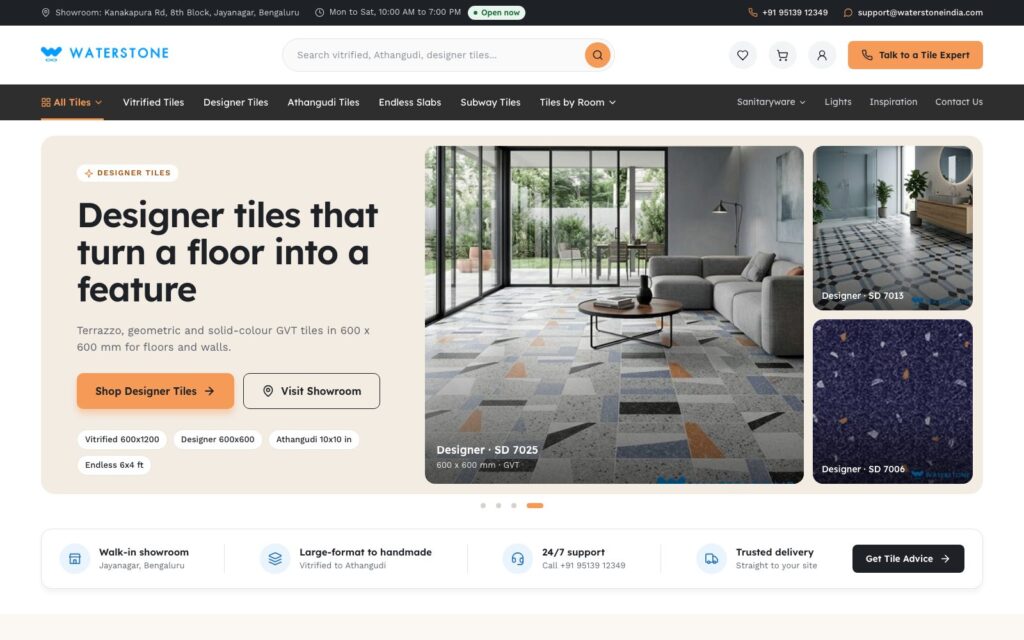
Waterstone India
A WooCommerce store for tiles and sanitaryware, with WhatsApp ordering.
I'm Paras, a freelance developer based in India. I set up Shopify stores ready for Indian buyers: Razorpay for UPI and cards, Cash on Delivery, GST invoices and a store designed by my team and built by me. The Store plan is ₹1,24,999 and takes 4 to 6 weeks. It costs the same on WooCommerce, so I will tell you which one fits your store.
You get a Shopify store ready to take orders from Indian customers, for a fixed ₹1,24,999 in 4 to 6 weeks. My team designs it; I build, launch and support it, and you deal with me directly throughout.
Not included: Shopify's subscription, paid apps and your domain, all billed at actual cost in your name. Photography and copywriting are add-ons, and GST is extra if applicable. You pay 50% to start through Razorpay and the balance after you approve the finished store. Details are on my plans page.
Indian D2C brands and small businesses that want to sell online without running a server: a new brand opening its first store, or a seller moving from Instagram and WhatsApp orders to a proper checkout. If your store depends on blog content or an unusual buying flow, I will usually point you to WooCommerce instead.
Shopify Payments, Shopify's own gateway, is not available in India: it is missing from Shopify's list of supported countries. So Indian stores take online payments through a third-party provider such as Razorpay, which shapes both the fees and the setup. If a quote for an Indian store promises Shopify Payments, ask how.
Razorpay connects to Shopify through its Razorpay Secure app, which covers UPI, cards, wallets and netbanking, according to Razorpay's Shopify guide. Razorpay reviews your website before the integration, and only the account owner can connect the two accounts, so open your Razorpay account early.
Shopify handles COD as a manual payment method, so it works without an app. Rules are another matter: limiting COD by pin code or order value, or adding a COD fee, usually needs an app. Worried about fake COD orders? We agree those rules before launch.
Do not assume Shopify produces a GST-compliant invoice, with your GSTIN, HSN codes and tax split shown properly, out of the box. An invoicing app does it, and I configure it before launch. Shiprocket and similar aggregators connect through an app too, so you create labels inside the store.
There are two bills: my one-time ₹1,24,999 build fee, and Shopify's subscription, paid to Shopify for as long as the store runs. Here is Shopify's India pricing page as I read it on 25 November 2026.
| Basic | Grow | |
|---|---|---|
| Billed yearly | ₹1,499 a month | ₹5,599 a month |
| Billed monthly | ₹1,994 a month | ₹7,447 a month |
| Shopify's fee on third-party payments such as Razorpay | 2% | 1% |
New stores get 3 days free, then ₹20 a month for 3 months. On top of the plan sit Razorpay's own fee on each payment, any paid apps and your domain.
A worked example. Basic billed yearly comes to ₹17,988 a year. If ₹1,00,000 of orders a month come in through Razorpay, Shopify's 2% adds ₹2,000 a month, before Razorpay's own fee. Grow halves that percentage but costs ₹4,100 more a month on yearly billing, so on fees alone it only pays off once online orders pass about ₹4,10,000 a month. For the line-by-line picture, read what a website really costs in India.
Shopify is the right platform when nobody on your team wants to own servers, updates and security. My Store plan is the same price on both platforms.
Pick Shopify if:
If you want low running costs, content-led SEO (Shopify fixes product and collection URLs under /products/ and /collections/) or custom flows such as WhatsApp ordering, WooCommerce usually fits better.
The full comparison is in WordPress vs Shopify for an Indian online store. For a WooCommerce build, see ecommerce website development in India.
Keep apps to the ones the store needs: they are the running cost that creeps up, many billed monthly and often in US dollars. I buy only what your store needs, in your name, and tell you the monthly total before launch. Every build also gets correctly sized images, lazy loading and a PageSpeed Insights check before it goes live.
Five steps take you from first call to a live store. The 4 to 6 week clock starts once the advance, your content and your logins are in.
DIY suits a small catalogue and spare time, an agency suits brands that need a whole team, and a freelancer suits owners who want to deal with the person writing the code.
I have not published a Shopify case study yet. Shopify is one of the platforms behind the 100+ sites and apps I have shipped since 2022, but the projects written up here are WordPress, WooCommerce and web app builds.
The closest example is Waterstone India, a WooCommerce store for tiles and sanitaryware with cart, wishlist, accounts and WhatsApp ordering for buyers who want to talk before they pay. It is not Shopify, but it shows how I plan around the way Indian customers buy. The rest is on my work page, and for a WordPress site, see WordPress developer in India.
Ask each developer on your shortlist these questions, and get the answers in writing.
If you want my answers to those, send me the details. I reply within one working day with a written quote.
A short call about your goals, then a written quote with scope and timeline.
Pay the advance on Razorpay. Invoice and kickoff form follow within one working day.
I map every page first, my design team draws the key screens, and we review them together.
I build on a private staging link you can check any time.
You approve and pay the balance. I launch and support you for 30 days.
My Store plan is ₹1,24,999, one-time, for a Shopify or WooCommerce store in 4 to 6 weeks. It includes store design by my design team, Razorpay and Cash on Delivery, shipping, GST invoices, 50 products added, on-page SEO and product schema. Shopify's subscription, apps, photos and copywriting are extra, GST is extra if applicable, and you pay 50% to start.
On Shopify's India pricing page in November 2026, Basic is ₹1,499 a month billed yearly or ₹1,994 billed monthly, and Grow is ₹5,599 a month billed yearly or ₹7,447 billed monthly. New stores get 3 days free, then ₹20 a month for 3 months. Apps, your domain and payment gateway fees come on top.
Shopify Payments is not available in India, so online payments go through a third-party provider such as Razorpay. On those, Shopify charges its own fee: 2% on Basic, 1% on Grow and 0.6% on Advanced, according to its India pricing page. Razorpay's fee is separate. On ₹1,00,000 of Razorpay orders on Basic, ₹2,000 goes to Shopify.
Yes. Razorpay's Razorpay Secure app adds UPI, cards, wallets and netbanking to a Shopify checkout, after Razorpay has reviewed your website. Cash on Delivery works as a manual payment method without an app. Rules such as limiting COD to certain pin codes or order values usually need an app, and we agree them before launch.
It is worth it if you never want to deal with hosting, updates or security, and you accept a monthly subscription plus a fee on every Razorpay order. If your store will grow through blog content or needs custom flows, WooCommerce usually costs less to run. My Store plan is the same price on both, so pick on fit.
Not yet. Shopify is one of the platforms behind the 100+ sites and apps I have shipped since 2022, but none of those stores is written up as a case study. My published work is WordPress, WooCommerce and web apps, including the Waterstone India WooCommerce store. I would rather say that than show you a store I did not build.
The Store plan takes 4 to 6 weeks, counted from when the advance, your content and your logins are in. Ready product photos and descriptions speed it up the most, and late content moves the date by the same amount. Razorpay also reviews your website before the integration, so I plan for that in the timeline.
Secure checkout · Razorpay