How much does a website cost in India in 2026? Real prices, line by line
By Paras Chaturvedi, freelance full stack developer based in India. Updated November 2026.
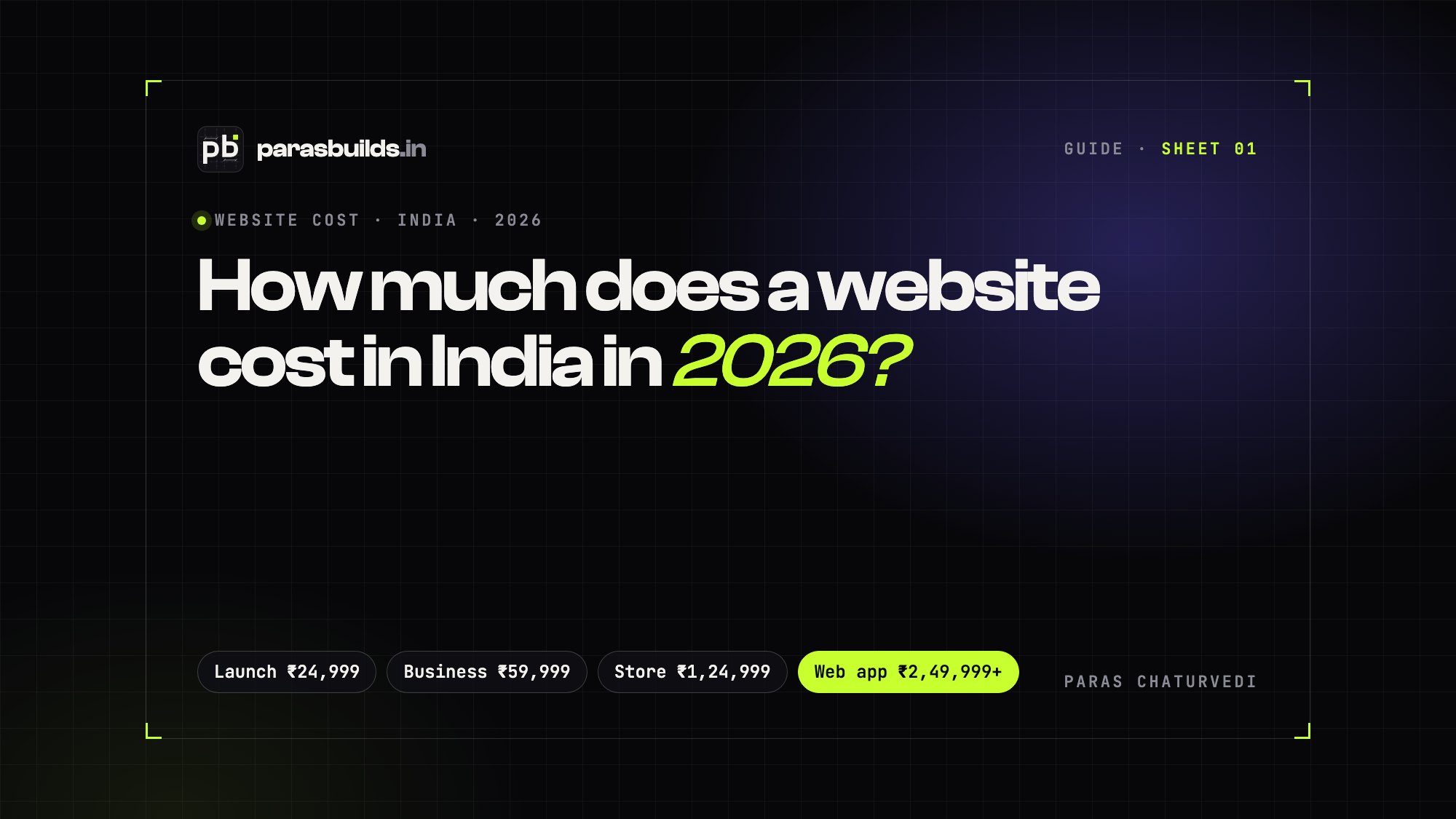
In 2026, a website in India can cost anything from a few thousand rupees for a template to several lakh for a custom web app. My own fixed prices are ₹24,999 for a landing page, ₹59,999 for a 5 to 8 page business website, ₹1,24,999 for an online store and from ₹2,49,999 for a custom web app. Domain and hosting come on top, usually a few thousand rupees a year.
Two quotes for “a website” can be ₹10,000 and ₹1,00,000 apart, and both can be fair. The difference is what sits inside them. Here is every line, with real numbers where I can give them.
Website cost in India at a glance
| Type of website | What you get | My price | Delivery |
|---|---|---|---|
| Landing page | One long page for an ad campaign, a launch or a single service | ₹24,999 | 7 to 10 days |
| Business website | 5 to 8 pages, blog, forms, on-page SEO | ₹59,999 | 3 to 4 weeks |
| Online store | WooCommerce or Shopify, payments, shipping, up to 50 products added | ₹1,24,999 | 4 to 6 weeks |
| Custom web app | Next.js or MERN, logins, dashboards, APIs | from ₹2,49,999 | 8 to 12 weeks |
All four are one-time prices for design and build. The running costs further down are separate, and you pay them whoever builds your site.
Why website quotes in India vary so much
The biggest factor is not the number of pages. It is how much of the work is actually done for you.
- Template or custom design. Installing a theme and swapping in your logo takes hours. Designing around your business takes days.
- Who does the work. A student, an experienced freelancer and an agency with account managers all have different costs.
- What is included. SEO setup, speed work, analytics and support after launch are sometimes in the price and sometimes quietly missing.
- Features. Payments, bookings, logins and integrations all add time.
So the useful question is not “is ₹15,000 cheap?” It is “what am I getting, and what will I pay for later?”
The line items, one by one
1. Design and development
This is the main cost, paid once. It covers planning, design, build, mobile layouts, forms and testing. The price moves mostly with the number of distinct layouts and features, not the raw page count: ten service pages sharing one template cost far less than ten pages that each need their own design.
2. Domain name
A .com or .in domain usually costs somewhere between ₹500 and ₹1,500 a year, depending on the registrar and the extension. Look at the renewal price, not just the first-year offer, because the two can be very different. Most important of all: the domain must be registered in your name, with the login in your hands.
3. Hosting
A small business website runs comfortably on good shared or managed WordPress hosting, which typically costs a few thousand rupees a year. A busy store or a web app needs a cloud server or VPS, which costs more and needs someone to look after it. On Shopify, hosting is part of the monthly subscription.
4. SSL certificate
SSL puts the padlock in the browser bar. Most decent hosts include a free certificate from Let’s Encrypt, so for a normal business website this line should be zero.
5. Business email
An address like you@yourbusiness.in is optional but worth having. Google Workspace and Zoho Mail charge per user per month, and some hosting plans include basic mailboxes.
6. Premium themes, plugins and apps
Some features need paid tools: a booking system, a GST invoice plugin for WooCommerce, or Shopify apps. Many renew yearly or monthly, often priced in US dollars. A good developer flags these before you commit and buys them in your name.
7. Payment gateway fees
If you sell online, the payment gateway takes a small cut of each payment. Razorpay, for example, charges a percentage per transaction, around 2% on its standard plan for most Indian payment methods at the time of writing, plus GST on that fee. Check the gateway’s current pricing page before you plan your margins, because rates change and differ by payment method.
8. Content: words and photos
Content is the line people forget. Writing your own text and supplying photos costs time rather than money. A copywriter or a product shoot is extra; in my plans, copywriting is a listed add-on.
9. Support and maintenance
WordPress and its plugins need updates, backups need checking, and small changes always come up. My plans include 30 days of support after launch. After that, upkeep is yours or a monthly or per-task arrangement with your developer.
A worked example: the first-year cost of a business website
Here is what a typical 6 page business website costs in its first year with me, using honest ranges for the parts I do not control.
| Item | Cost | How often |
|---|---|---|
| Design and build (Business plan) | ₹59,999 | One-time |
| Domain (.in or .com) | about ₹500 to ₹1,500 | Yearly |
| Hosting (shared or managed WordPress) | about ₹2,000 to ₹8,000 | Yearly |
| SSL certificate | ₹0 with most hosts | Renews automatically |
| GA4 and Search Console setup | Included | One-time |
| Support for 30 days after launch | Included | One-time |
| Approximate first-year total | about ₹62,500 to ₹69,500 | Before business email and add-ons |
From the second year on, you are only paying for the domain and hosting, plus any maintenance you choose. If GST applies to your developer’s invoice, add it to the build cost.
How much do freelancers charge for a website in India?
Freelance prices in India run from a few thousand rupees to several lakh. At the low end you usually get a template installed with your content. Further up, you pay for custom design, proper speed and SEO work, and someone who still answers your messages after launch. Freelancers are often cheaper than agencies for the same work because there are no account managers in the price. The trade-off is that you depend on one person, so check their past work and ask how they handle support.
How much advance do web developers take?
Asking for 30% to 50% upfront is normal for freelancers and small studios in India. The advance books the developer’s time and covers the planning and design work at the start. I take 50% to start and 50% after you approve the finished site, before it goes live. For custom web apps, billing follows milestones: 40% to start, 40% at an agreed midway point and 20% at handover. Whatever the split, it should be in writing, and you should receive an invoice for every payment.
How to compare two website quotes
Put the quotes side by side and ask each developer the same questions:
- Which pages get a unique design, and is it custom or a theme?
- Whose name will the domain, hosting and paid plugins be in?
- Do I own the code and design after the final payment?
- How many revision rounds are included?
- What support do I get after launch, and for how long?
- Is basic SEO included: titles, meta descriptions, schema, Search Console?
- What exactly is not included?
A quote that answers these in writing is worth more than a cheaper one that answers none.
Red flags that make a cheap website expensive later
- The domain is registered in the developer’s name, not yours.
- “Unlimited revisions” with no written scope. It sounds generous and usually ends in an argument.
- Pirated, or “nulled”, premium plugins, which are a well-known way for malware to get into WordPress sites.
- No mention of hosting, backups or who fixes things when they break.
- No written quote, no contract and no invoice.
Frequently asked questions
How much does a website cost in India?
From about ₹25,000 for a landing page to ₹60,000 for a small business website and ₹1,25,000 or more for an online store, with custom web apps from around ₹2.5 lakh. Those are my prices; others vary with what they include. Domain and hosting add a few thousand rupees a year.
Are domain and hosting included in the website price?
In my plans, no. They are billed at actual cost and registered in your name, so you own them outright. If a developer bundles them in, ask whose name they are in and what renewal costs.
How long does it take to build a website?
About 7 to 10 days for a landing page, 3 to 4 weeks for a business website, 4 to 6 weeks for a store and 8 to 12 weeks for a web app. Late content is the usual cause of delay.
Do I have to pay GST on a website?
If your developer is registered for GST, web development is generally billed with 18% GST on top, which a GST-registered business can usually claim back as input tax credit. Either way, ask for an invoice for every payment.
Where to go from here
The four packages and everything they include are on my plans and pricing page. To see what these prices pay for, look at the Acenteus Accounting website or the Waterstone India store. If your project does not fit a box, send me the details for a written quote.